For decades, scientists believed that the human brain’s billions of neurons ran exclusively on sugar (glucose) for energy. That long-held assumption has just been upended by a groundbreaking discovery: neurons can also burn fat as fuel. In fact, when the brain’s energy demands spike, neurons even manufacture their own fat supplies by recycling parts of their cellular structure – a process that hinges on a crucial protein called DDHD2.
This surprising insight isn’t just a biochemical curiosity; it opens the door to new ways of treating metabolic brain disorders that were previously deemed untreatable.
Researchers from the University of Helsinki (Finland) and the University of Queensland (Australia) led the study, which was published in the journal Nature Metabolism. By revealing an alternative “fat-fueled” energy pathway in the brain, their work promises to rewrite neuroscience textbooks and offers hope for patients with a range of neurological conditions.
“For decades, it was widely accepted that neurons relied exclusively on glucose to fuel their functions in the brain,” notes Dr. Merja Joensuu of UQ’s Australian Institute for Bioengineering and Nanotechnology (AIBN). “But our research shows fats are undoubtedly a crucial part of the neuron’s energy metabolism in the brain and could be a key to repairing and restoring function when it breaks down”. In other words, tapping into fat as a brain fuel could be a game-changer for medicine, potentially revolutionizing treatments for brain diseases that involve energy deficits.
Key Points
-
Neurons can use fat for energy: Brain cells are not limited to sugar (glucose) – they can burn fatty acids as an alternate fuel source, overturning a long-held belief.
-
Neurons create their own fat fuel: When energy demand is high, neurons produce fats by recycling their own cell parts, a process dependent on the DDHD2 protein.
-
Role of DDHD2 and HSP54: In the rare neurological disorder Hereditary Spastic Paraplegia type 54 (HSP54), a mutation in the DDHD2 gene cripples the neuron’s fat-burning ability, leading to early-onset neurodegenerative symptoms.
-
Fatty acids restore neuron function: Laboratory tests showed that adding specific fatty acid supplements to DDHD2-deficient neurons restored their energy production and normal function within 48 hours – something extra sugar alone could not achieve.
-
Path toward new treatments: The team is now moving to pre-clinical trials to test fat-based therapies in disease models. They are also using advanced brain imaging to track these treatments, with hopes that this strategy might help not only HSP54 patients but also people with other neurodegenerative diseases.
Burning Fat in the Brain: A New Paradigm
The human brain is a notoriously hungry organ, demanding a constant supply of energy. Until now, textbooks taught that this energy came almost entirely from glucose. The new research upends that notion by demonstrating that neurons have a hidden metabolic talent – they can burn fatty acids for energy, just like muscles and other tissues do. Even more striking, neurons actively synthesize their own fat-based fuel when needed: they break down parts of their internal membranes or other cellular components to generate fatty acids on the fly. This built-in “fat factory” within our brain cells helps power critical activities like thinking and movement, especially when extra energy is required.
How do neurons accomplish this feat? The key is DDHD2, a protein encoded by a gene of the same name. DDHD2 functions like a molecular linchpin for the brain’s fat metabolism. It enables neurons to convert bits of their cellular anatomy into usable fuel, ensuring the brain has an energy back-up plan when glucose alone isn’t sufficient. “We discovered that neurons use small fat molecules, called saturated free fatty acids, produced by DDHD2 for energy to sustain neuronal communication,” explains Dr. Joensuu, who conceived the project and led the study. In essence, DDHD2 allows neurons to tap into an internal reserve of energy by mobilizing fats, which is a previously unrecognized aspect of brain physiology.
This paradigm shift in understanding brain metabolism is a big deal for neuroscience. It challenges the conventional wisdom that governed neurological research for decades. If neurons normally rely on fats alongside sugar, scientists will need to rethink how brain energy deficits contribute to disease and aging. The finding also suggests new nutritional or metabolic interventions could support brain health. As Dr. Joensuu put it, “This was a huge paradigm shift”, revealing an alternative fuel that could be the missing piece of the puzzle for treating certain brain disorders. Researchers are now looking at the brain in a new light – not as a purely sugar-driven organ, but as a hybrid engine that can run on two fuel sources. That insight opens exciting possibilities for therapy.
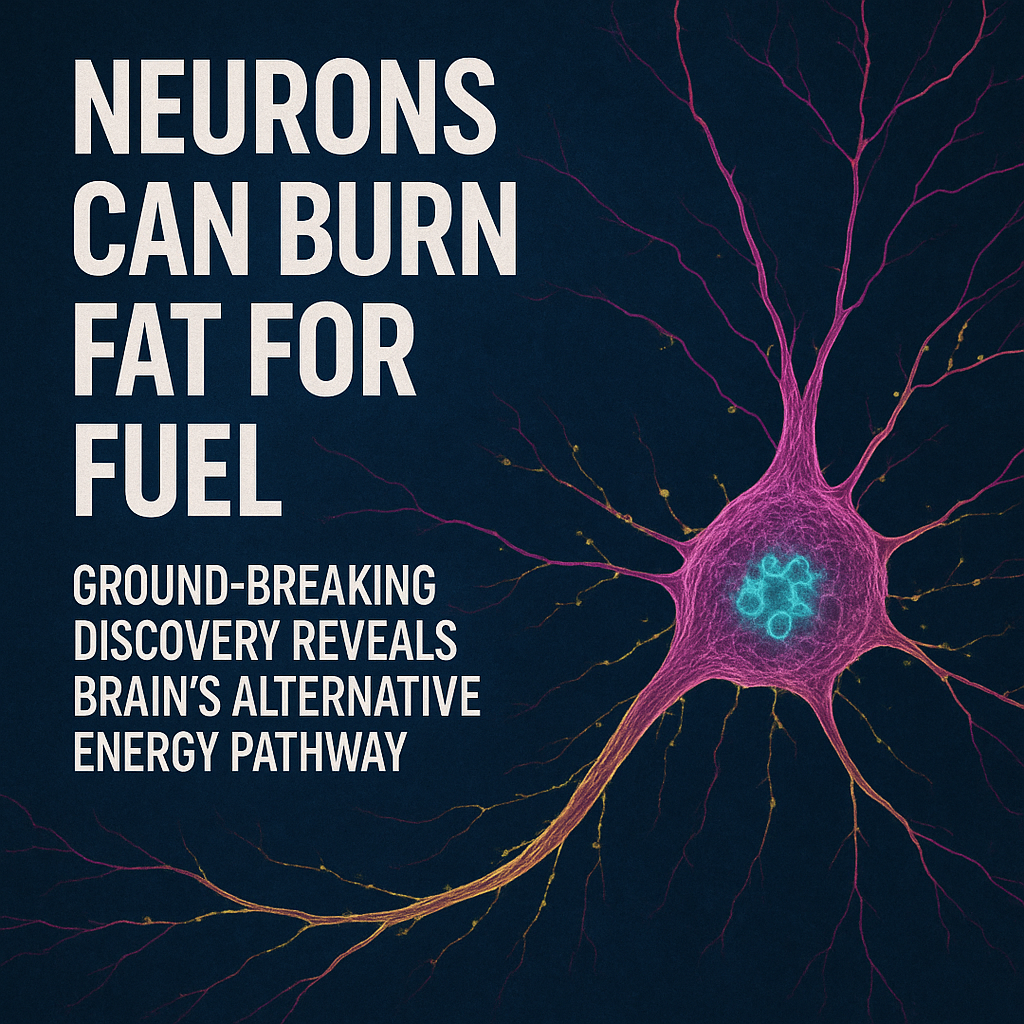
Fluorescence microscopy reveals the presence of fat-related components inside neurons. In this image, a hippocampal neuron is shown in magenta, with the critical DDHD2 protein highlighted in cyan and the cell’s internal membranes in yellow. Such images illustrate how neurons store and utilize fatty molecules internally as an energy source, underscoring the study’s finding that our brain cells can be “fat-fueled.”
When Fueling Fails: HSP54 and the DDHD2 Connection
The importance of the DDHD2-driven fat fuel system becomes tragically clear in a rare genetic brain disorder called Hereditary Spastic Paraplegia type 54, or HSP54. In this condition, patients inherit mutations that make the DDHD2 protein non-functional. As a result, their neurons cannot produce or use fats for energy properly. Essentially, the brain’s backup power generator fails. Without the ability to burn fat, neurons become overly dependent on sugar and struggle to meet their energy needs. This leads to neurons falling silent or “powering down,” which disrupts vital communication between nerve cells.
HSP54 is a devastating illness, though fortunately very rare. Children with HSP54 often begin to show neurological problems at a young age. Early signs include difficulty with movement and cognitive development, as the neurons responsible for controlling muscles and processing information start to malfunction. Over time, these symptoms worsen. The term “spastic paraplegia” refers to muscle weakness and stiffness in the legs, but HSP54 patients can also experience seizures, intellectual disability, and other issues as the brain’s networks break down. All of this stems from a single genetic flaw: the loss of DDHD2 throws off the brain’s fat balance, depriving neurons of a crucial energy source. “The loss of the DDHD2 gene function was known to disturb the brain’s fat balance, which ultimately heralded the onset of HSP54,” Dr. Joensuu noted. In other words, without DDHD2 the brain essentially runs out of gas, and neurons can no longer fire properly.
Understanding HSP54 gave the scientists a vital clue. It provided a real-life example of what happens when neurons cannot use fats. Studying cells from HSP54-affected models, Dr. Joensuu and colleagues observed that those neurons were energy-starved and malfunctioning – confirming that the fat-fueling pathway is not just a back-up, but truly essential for normal brain function. This insight suggested that if one could somehow restore fat metabolism in those cells, the neurons might recover. It also hinted that other brain disorders which involve metabolic problems might benefit from therapies targeting this fat-burning mechanism. The stage was set to test whether reactivating the fat fuel pathway could rescue failing neurons.
Fat to the Rescue: Reviving Neurons in 48 Hours
Armed with their new understanding, the researchers set up a simple but dramatic laboratory test. They took neurons that lacked working DDHD2 – mimicking the situation in HSP54 – and tried to revive them by feeding them fat. Specifically, they exposed the damaged neurons to supplements of specific fatty acids (the type of small fat molecules neurons use for fuel) and waited to see what would happen. The result was nothing short of astonishing: within just 48 hours, the once-flagging neurons regained their energy production and returned to normal activity. Essentially, the cells “came back to life” in a matter of days, firing signals and functioning as healthy neurons would.
This rapid recovery was a eureka moment for the team. It demonstrated that the problems in HSP54 neurons aren’t necessarily permanent – they stem from a fuel shortage that can be fixed. By giving the cells an alternate source of the fuel they couldn’t make on their own, the scientists effectively bypassed the genetic defect. It’s comparable to jump-starting a car with a dead battery: the neuron’s engine wasn’t broken, it was just out of fuel, and the fatty acids provided that missing energy supply. Notably, earlier attempts to revive these neurons with extra glucose (sugar) had failed to improve their condition. That finding underscores how essential the fat pathway is – simply flooding the cells with more sugar couldn’t substitute for what they lacked. The success with fatty acids, on the other hand, proved that restoring fat metabolism directly addresses the root of the problem.
“This is a real game-changer,” said Dr. Merja Joensuu, describing the significance of seeing neurons rebound so quickly with the fat treatment. Dr. Joensuu conceived the project and led the study, splitting her time between labs at UQ’s AIBN and the Queensland Brain Institute. “We’ve shown that healthy neurons rely on fats for fuel, and when this pathway fails in conditions like HSP54, it may be possible to repair the damage and reverse the neuropathologies,” she explained. In other words, the neuronal damage once thought irreversible might be undoable – if you can restore the cell’s ability to generate energy from fats, the neuron can heal itself and resume normal function. Such reversal of neuropathology (brain cell damage) is rarely seen, which is why this result has researchers excited. It hints at a whole new therapeutic strategy: treat the metabolic deficiency, and you can revive dying neurons.
The laboratory findings not only offer hope for HSP54 patients, but also validate the broader concept that some neurodegenerative conditions might be treated metabolically. Many brain diseases, from Alzheimer’s to Parkinson’s, involve neurons that are struggling energetically and metabolically. The newfound ability to “fuel up” neurons with fat could become a general tool to boost brain cell health. As Dr. Joensuu noted, understanding this alternative brain fuel could unlock more effective ways to treat various energy-related brain disorders. Seeing sick neurons spring back with a simple fatty supplement provides a tantalizing glimpse of what future fat-based therapies might achieve.
Next Steps: Toward Trials and New Therapies
With proof-of-concept in hand, the researchers are now racing to translate this discovery into a real treatment. The next phase involves pre-clinical trials – testing the safety and effectiveness of fatty acid-based interventions in living models of disease. Before any human patients receive such a therapy, it must be shown to work in animals and to pose no serious side effects. Over the coming months, the team will be administering these “fat fuel” supplements in laboratory mice and other pre-clinical systems that mimic HSP54 and related conditions. These studies are essential to determine proper dosages, delivery methods (for example, can fatty acids cross the blood-brain barrier?), and to ensure that restoring fat metabolism doesn’t have unintended consequences. It’s a cautious but determined march toward clinical trials in human patients.
Alongside the biochemical treatment tests, the scientists are also embracing cutting-edge brain imaging technologies to guide their progress. “We will continue the exciting collaboration with new non-invasive technologies to image the brain and therefore aid a faster development of the potential therapy,” said Dr. Giuseppe Balistreri from the University of Helsinki. Dr. Balistreri, a co-leader of the study, emphasizes that advanced imaging – such as high-resolution MRI or PET scans – will allow the team to watch the brain’s energy usage in real time. By visualizing how neurons take up and metabolize the fatty acids, they can quickly see whether the treatment is working and refine it accordingly. This non-invasive peek into the brain will accelerate the research, helping answer key questions like: Do the supplemented fats actually reach the neurons that need them? Are they being burned for energy as expected? Such insights will speed up development on the road to a viable therapy.
Perhaps most exciting are the broader implications of this work. If a fatty acid cocktail can revive neurons in one genetic disorder, could it do the same in others? The researchers are optimistic. They plan to investigate whether this fat-based energy pathway also plays a role in more common neurodegenerative diseases that currently lack effective treatments. The brain’s metabolism is known to shift in conditions like Alzheimer’s disease, where neurons become less adept at using glucose. It’s tantalizing to imagine that boosting fat utilization might counteract some of that metabolic decline. In fact, given the brain’s inherent metabolic vulnerability, the team believes this discovery might be a “missing piece of the puzzle” for a number of debilitating illnesses. By targeting the cell’s energy source, future therapies could bolster neuron survival and function across a spectrum of diseases. It’s a fundamentally new approach – treating neurological disorders by feeding the brain in a smarter way.
Dr. Balistreri underscores the magnitude of what lies ahead: “This breakthrough doesn’t just rewrite the textbooks, it could transform lives,” he said. The collaboration between Helsinki and Queensland will continue as they push this innovation forward, united by the goal of transforming a lab discovery into a life-changing treatment.
A Hopeful Future for Patients
While there is still much work to do before fat-fueled brain therapies become reality, the mood in the scientific community is optimistic. This discovery has injected new hope into a realm of medicine that often sees slow progress. For patients and families affected by rare metabolic brain disorders like HSP54, it’s a beacon of possibility where previously there was none. The idea that a relatively simple nutritional intervention – providing the right kind of fat – can literally restore life to dying neurons is inspiring scientists to rethink other diseases as well. If the upcoming trials are successful, we could be looking at a future where doctors treat certain neurodegenerative conditions not just with drugs, but with targeted metabolic supplements that energize the brain from within.
Beyond individual diseases, the broader message is profoundly encouraging: our brains are more metabolically flexible than we thought. They have untapped resilience. By leveraging that flexibility, we might keep our neurons healthier for longer, staving off decline in aging and disease. It’s a shift from viewing the brain as fragile to seeing it as adaptable – capable of switching fuel sources when given the right support. The researchers involved are quick to point out that this is not just about academic insight, but about human impact. Their laboratory neurons regained their spark, and with it comes the promise that people’s lives could be changed. In the words of Dr. Balistreri, this breakthrough stands to “transform lives”, offering a new lifeline to those with conditions once deemed beyond help.
As science moves from discovery to delivery, the world of brain health is watching closely. A revolution in treatment may be on the horizon – one where fat-fueled neurons help heal broken connections and restore hope to patients everywhere. The next chapters will be written in clinical trials and imaging labs, but the take-home message today is clear: the brain has more than one way to power itself, and that revelation could power a new era of neurological therapy. The future for brain disease treatment suddenly looks brighter, fueled by a bold idea and, fittingly, a little bit of fat.